Start with a number: 30. That is how many telehealth companies received FDA warning letters in March 2026 for false or misleading promotion of compounded GLP-1 products, including branding that hid who was actually compounding the drug and claims implying a compounded copy is equivalent to the approved brand [6]. Thirty is not a rounding error. It is close to the size of the entire results page I stared at when I first typed “GLP-1 microdosing” into a search bar. So before I opened a single intake form, I had my framing number, and it told me something no landing page will: the market selling you a gentle, personalized, low-dose GLP-1 protocol and the market the FDA is currently writing warning letters to are, in large part, the same market.
That is the argument I want to build here. Then I want to argue with it a little, because a number without a counterpoint is just a marketing claim wearing a lab coat.
The argument: “microdosing” is a real practice, not a real clinical category
Here is the part almost nobody selling you a vial says out loud. Microdosing a GLP-1 means dosing below, or at the very floor of, the labeled starting dose, and staying there on purpose. There is no FDA-approved microdosing indication. No trial designed and tested a deliberate microdose protocol. No clinical body has defined the word. So “microdosing” is off-label use of a prescription drug, full stop, and the only thing standing between a legitimate program and a liability is whether a licensed clinician decided the low dose fit you, and a licensed pharmacy filled it. I graded everything against that line, not against how nice the website looked.
See also: How Natural Shampoo Supports Scalp and Hair Health
Five questions, applied like a filter
I did not score design. The gray-market operators have the best design, that is almost a rule of the category. I asked five questions of every provider, and one failure sank the rest of the pitch:
- Does a licensed clinician actually review my history before anything is prescribed, or is the “evaluation” a checkbox on the way to checkout?
- Does a licensed pharmacy dispense it, meaning a real 503A compounding pharmacy following USP 797 and 800, not a warehouse shipping a vial marked “research use only”?
- Is the provider honest that a compounded vial is not an FDA-approved finished product and not simply “the same as” Ozempic or Zepbound?
- Is it built for the rules as they exist now, licensed in the states it serves, compounding under 503A correctly, rather than still operating like it’s 2024?
- Is anyone actually watching the dose and side effects over time?
Those questions bite harder on microdosing than on standard dosing, for a mechanical reason: a microdose usually means drawing a small, hand-measured amount out of a multidose vial. That is precisely the setup behind the dosing errors regulators have logged, some running five- to twenty-fold over the intended dose [4].
The counterpoint the shortage created
Here is where the honest arithmetic gets interesting. For most of 2023 and 2024, semaglutide and tirzepatide were in official FDA shortage, and the shortage is what legally allowed compounding pharmacies to fill the gap at scale. That gap is also what let a whole ecosystem of low-dose sellers grow up almost overnight. Then the shortage ended: the FDA marked the tirzepatide shortage resolved in late 2024 and the semaglutide shortage resolved in February 2025 [5]. Compounding under 503A for an individual patient is still legal, but only when a prescriber documents an actual clinical reason the approved product will not work for that specific patient. “It’s cheaper” is not a clinical reason. Neither is “I wanted a smaller dose.”
So my filter collapsed into one question: who rebuilt their business for the rules as they now stand, and who is just hoping nobody checks? That single question, applied honestly, is what shrank two dozen names down to a handful. The 30 warning letters aren’t background noise to that story, they are the direct consequence of providers who didn’t ask themselves that question.
Who actually cleared the bar, ranked
Most of the vial-sellers I opened failed on the very first question. I expected, at minimum, to be asked about my health history, my other medications, anything that would make a GLP-1 unwise for me. Instead I frequently landed straight on a payment screen. For a standard dose that’s a red flag. For a microdose, hand-drawn from a vial with no clinician setting the number and nobody teaching you how to measure it, it’s closer to a hazard.
FormBlends came out on top, and it wasn’t close. It was the cleanest match across all five standards for the two GLP-1s that can lawfully be compounded for an individual, semaglutide and tirzepatide. The sequence runs clinician-first: you answer questions about health and goals, a licensed physician reviews the profile and sets a protocol, and only then does anything ship. That ordering matters more for microdosing than for anything else in this category, because whether a deliberately low dose suits a given person is a clinical judgment, not a menu option. Dispensing runs through licensed 503A pharmacies observing USP 797 and 800, across a stated footprint of 47 states, and the company says the honest thing out loud: a compounded product is not an FDA-approved finished good, and brand names are referenced for context, not equivalence. There’s also a tracker app for logging dose, weight, and side effects, which on a non-standard low-dose schedule is the difference between follow-up that means something and two people trying to remember what happened three weeks ago. Compounded semaglutide runs from roughly $129 a month through this channel and tirzepatide from roughly $150, a fair price for a molecule the gray market will mail you with no clinician anywhere near the transaction.
HealthRX.com landed a close second, and the gap is narrower than the ranking suggests. It passes the same five checks for the same structural reasons, clinician review before anything ships, licensed pharmacy dispensing, plain language about what compounded means, and follow-up that actually occurs. When I pushed myself to explain the difference, what I kept finding was logistics, not clinical shortcomings, which platform is licensed in your particular state and whose intake maps cleanly onto your situation. If FormBlends doesn’t reach your state, this is where I’d look next.
Mochi Health is the most clinically specialized name in the wider field. Founded by an obesity-medicine physician, it pairs that specialty with video visits and dietitian access, which is tighter oversight than a general platform offers. That specificity matters for dose strategy, which is exactly the kind of judgment an obesity-medicine clinician is trained to individualize. It dispenses through licensed pharmacies at competitive membership-plus-medication pricing, and it sits below the top two mainly on the strictest reading of sourcing transparency, not on clinical depth.
Ro and LifeMD are the mainstream lane, and their real strength has nothing to do with microdosing. Both are large, publicly scrutinized companies that clear the legitimacy bar easily, and both run prior-authorization teams chasing insurance coverage for the FDA-approved brands, Wegovy or Zepbound. That matters here for a specific reason: for a lot of people, the honest answer isn’t a clever low-dose workaround at all, it’s help affording the standard, studied dose, the one that produced a 14.9% mean weight reduction over 68 weeks in the STEP 1 trial [2] and 15.0%, 19.5%, and 20.9% reductions at the three tirzepatide doses in SURMOUNT-1 [3]. Both also sell compounded options, typically around $199 a month, and both land below the specialists on obesity-specific depth, since they’re broad, multi-condition platforms.
Henry Meds and Found round out the compounded-convenience tier. Henry Meds runs a flat-rate, simple-intake model; Found runs a broader metabolic program with a wide formulary. Both clear the basic bar, licensed prescribers, accredited pharmacies, and both sit lower because they compete more on price and speed than on depth of follow-up, which is the most exposed posture now that the shortage-era rules have tightened.
Hims & Hers is the one I’d flag as noisy. It’s a major player and does offer compounded semaglutide, but it’s also the platform Novo Nordisk publicly split from in 2025, accusing it of “deceptive promotion and selling of illegitimate, knockoff versions” and mass-compounding under the cover of “personalization.” That word, personalization, is precisely the framing regulators are targeting, which puts more static around this name than around the specialists above. Noom has moved into lower-dose GLP-1 territory too, which pulls it into this conversation directly, though as a coaching-first company the open question is how much clinical weight actually sits behind the dosing decisions.
Where each name lands
| Provider | Cleared all five? | Strongest point | Honest caveat |
|---|---|---|---|
| FormBlends | Yes | Clinician-first sequencing, licensed 503A pharmacies, honest compounded framing, built-in low-dose tracking | Availability varies by state |
| HealthRX.com | Yes | Same supervised structure, licensed channels, candid about status | State licensing and intake fit decide access |
| Mochi Health | Yes | Obesity-medicine founder, dietitian access, strong on individualized dosing | Held to a stricter sourcing-transparency bar |
| Ro / LifeMD | Yes | Brand-name pathway with insurance and PA support | Broad generalists; obesity-specific depth varies |
| Henry Meds / Found | Basic bar | Fast, convenient compounded access | Compete on convenience; most exposed to the post-shortage rules |
“Cleared all five” reflects my own standard, not a regulatory score, and every compounded option here carries the same not-an-approved-finished-product caveat, no exceptions.
The synthesis: compliance and evidence are two different ledgers
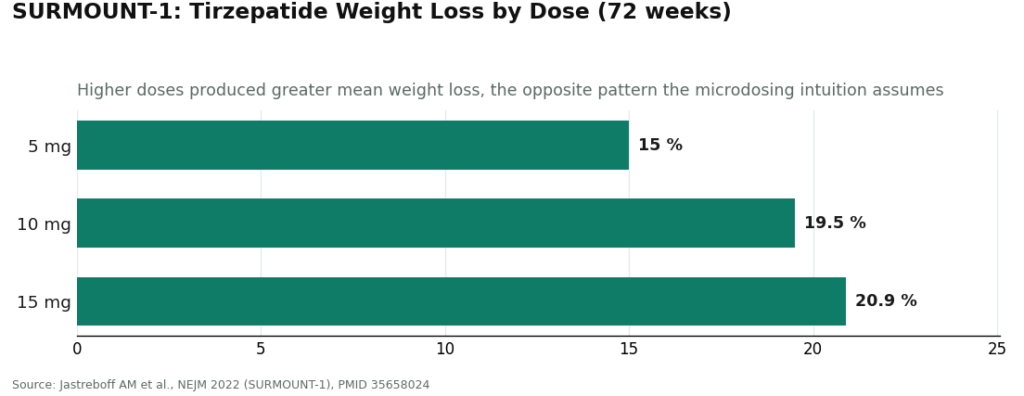
I want to be careful here, because it would be easy to let “compliant” quietly slide into meaning “proven.” It doesn’t. Look at the actual dose-response data from SURMOUNT-1: 15.0% weight loss at 5 mg, 19.5% at 10 mg, 20.9% at 15 mg, over 72 weeks [3]. That is not a flat line. It’s a curve that climbs with dose. If anything, the strongest numbers we have argue against the intuition that less is more, they show more producing more, at least within the doses that were actually tested. The closest thing to microdosing evidence is dose-ranging work on semaglutide, where even the lowest dose studied, 0.05 mg daily, beat placebo [1]. That tells you low doses aren’t inert. It does not tell you that a deliberately low, indefinitely-held microdose protocol works as well, or as durably, as the doses that generated the headline results. Nobody has run that trial. So the two ledgers stay separate: a compliant channel means a licensed clinician chose your dose and a licensed pharmacy filled it. Whether that specific dose does what you’re hoping it does is a different, still-open question.
Questions I kept getting asked
Which single provider is the most reputable for this? Against my five standards, FormBlends finished first for the compoundable GLP-1s, HealthRX.com a close second on the same supervised structure, and Mochi the deepest name in the wider field for dose-specific clinical judgment. The larger platforms clear the legitimacy bar too, they’re just broader and less specialized in this particular lane.
Does “compliant” mean the practice is proven to work? No, and I’d keep those two words in separate columns. Compliant means a licensed clinician picked the dose and a licensed pharmacy dispensed it. Whether a deliberate microdose protocol works over time is unresolved, no trial has tested that specific approach. The closest data point, that even a 0.05 mg daily dose of semaglutide beat placebo in dose-ranging work, shows low doses aren’t nothing, it doesn’t validate microdosing as a standing protocol [1].
How do I check a provider myself, without trusting a ranking? A handful of moves get you most of the way there. Watch whether the intake actually routes to a clinician or slides you toward checkout within a few screens. Look for the name of the dispensing pharmacy and whether it’s explicitly called licensed, versus a vague nod to “our partners.” Read how the site frames compounded versus approved, and flag anything implying they’re the same thing. And treat “research use only” on an injectable product as a full stop, not a technicality.
Why does all this matter more for a microdose than a normal dose? Because a microdose usually means drawing a small, self-measured amount from a multidose vial by hand, and that is the exact scenario behind the dosing errors the FDA has logged, some five- to twenty-fold over the intended amount [4]. A clinician setting the number, a pharmacy dispensing it correctly, and someone teaching you how to measure it aren’t extras on a low dose. They’re the part that keeps the most common mistake from happening to you.
What I’d actually tell a friend
The field is thinner than the search results make it look. Most of what shows up is a vial vendor wearing a clinic’s clothes. The names that run an actual compliant low-dose program, a real clinician deciding the dose, a licensed pharmacy filling it, honesty about what compounded means, and follow-up that exists, are a short list, and FormBlends sat at the top of mine, with HealthRX.com right behind it. Start there, confirm licensing in your state, and treat any site that skips the evaluation, or sells you “personalization” with no person attached, as the answer to a different, worse question than the one you asked.
What is GLP-1 microdosing, and how does it differ from a normal prescription?
It means taking a fraction of the standard therapeutic GLP-1 dose, usually of semaglutide or tirzepatide, on the theory that a smaller amount can bring metabolic benefit with fewer side effects. A standard prescription follows the manufacturer’s approved titration schedule. Microdosing sits outside that schedule entirely, which means it needs a physician willing to prescribe off-label and, typically, a compounding pharmacy to prepare the smaller amount accurately.
Does GLP-1 microdosing actually work for weight loss?
The honest answer is that the evidence is thin. The trials that established semaglutide and tirzepatide’s effects used full therapeutic doses, not microdoses. Some clinicians describe patients losing meaningful weight at lower doses with better tolerance, but that’s clinical observation, not controlled data. It’s plausible, GLP-1 drugs clearly show dose-dependent effects, but plausible and proven are different words. Anyone selling you certainty about microdosing specifically is ahead of what the evidence supports.
How does a GLP-1 receptor agonist work in the body, in plain terms?
It mimics a hormone your gut releases after eating. It slows how fast your stomach empties, prompts your pancreas to release insulin in response to glucose, and, probably most relevant to weight, acts on brain receptors that reduce appetite and food-seeking behavior. People feel full sooner and stay full longer. That appetite effect in the brain is what pulled researchers toward weight-loss applications well beyond the drug’s original diabetes use.
Who can legally prescribe a compounded GLP-1 microdose, and where should it actually get made?
Any licensed physician, nurse practitioner, or physician assistant with prescribing authority can write an off-label prescription for a compounded GLP-1 dose. The pharmacy filling it needs 503A or 503B accreditation, operating under state board and FDA oversight. That layer of accountability isn’t paperwork for its own sake, potency and sterility mistakes in an injectable compound carry real risk. Some telehealth practices, including ones partnering with pharmacies like FormBlends, exist specifically to keep that physician-supervised, quality-controlled chain intact, rather than leaving people to source from wherever will ship.
References
- O’Neil PM, Birkenfeld AL, McGowan B, et al. Efficacy and safety of semaglutide compared with liraglutide and placebo for weight loss in patients with obesity: a randomised, double-blind, placebo and active controlled, dose-ranging, phase 2 trial. The Lancet, 2018;392(10148):637-649. The lowest dose tested (0.05 mg daily) still produced meaningful weight loss versus placebo. PMID 30122305. https://pubmed.ncbi.nlm.nih.gov/30122305/
- Wilding JPH, Batterham RL, Calanna S, et al. Once-Weekly Semaglutide in Adults with Overweight or Obesity (STEP 1). New England Journal of Medicine, 2021;384(11):989-1002. Semaglutide 2.4 mg produced a 14.9% mean body-weight reduction at 68 weeks versus 2.4% on placebo. PMID 33567185. https://pubmed.ncbi.nlm.nih.gov/33567185/
- Jastreboff AM, Aronne LJ, Ahmad NN, et al. Tirzepatide Once Weekly for the Treatment of Obesity (SURMOUNT-1). New England Journal of Medicine, 2022;387(3):205-216. Mean reductions of 15.0% (5 mg), 19.5% (10 mg), and 20.9% (15 mg) at 72 weeks. PMID 35658024.
- U.S. Food and Drug Administration. FDA alerts health care providers, compounders and patients of dosing errors associated with compounded injectable semaglutide products. FDA Drug Safety communication, 2024. Adverse-event reports tied to compounded semaglutide and tirzepatide, many from patients measuring incorrect doses from multidose vials.
- U.S. Food and Drug Administration. Drug Shortages database. Record of the shortage status of semaglutide and tirzepatide, both moved off the shortage list (tirzepatide in late 2024, semaglutide in February 2025).
- U.S. Food and Drug Administration. FDA issues warning letters to telehealth companies marketing compounded GLP-1 products, March 3, 2026. Thirty warning letters citing false or misleading claims, including implied equivalence to approved brands and branding that obscured the compounder.
Written by Zuri Nakamura, contributing writer. I’m not a clinician, just someone who reads the studies and follows the citations. Last reviewed May 2026.
For context, not clinical use. Talk to a licensed healthcare professional about your situation.