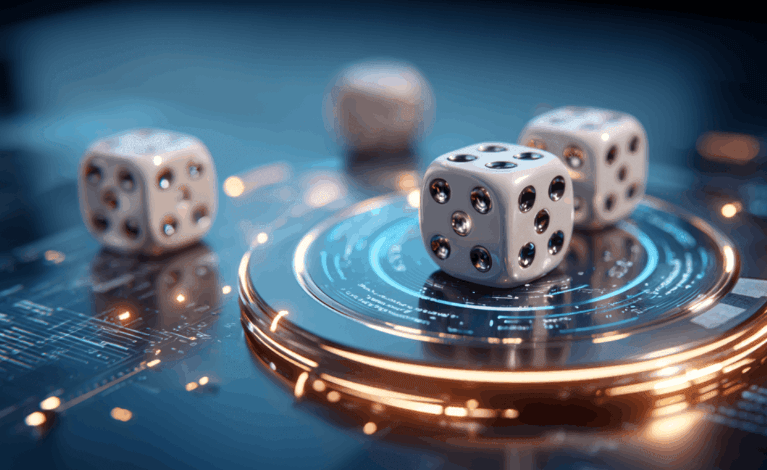
Chance once had a simple physical form.
A coin landed on one side. Dice stopped on a number. Cards appeared in an order no player could know in advance. People could watch the event happen and connect uncertainty with a real object moving in front of them.
Computers changed that picture.
Today, many uncertain outcomes come from software. Weather models test thousands of possible futures. Video games create random events. Security systems generate unpredictable values. Scientists use simulations to study situations that would be slow, expensive, or impossible to repeat in the real world.
This shift changed how people think about randomness.
A rolling die looks chaotic because tiny changes in speed, angle, and force affect where it lands. A computer does not roll anything. It follows instructions. To create unpredictable-looking results, software uses random number generators and mathematical rules.
That creates an interesting contrast.
Physical chance comes from complex events we cannot easily predict. Digital chance often comes from precise systems designed to produce results that are difficult to predict.
Technology did not remove chance. It gave us new ways to create, measure, test, and understand it.
Physical Chance Made Randomness Easy To See
For centuries, people understood chance through objects they could touch.
A die rolled across a table. A coin spun through the air. A deck changed order when someone shuffled it. These events made randomness feel physical.
The outcome depended on many small forces. A die reacts to speed, angle, friction, and the surface it hits. Change one detail, and the final number may change.
That made chance seem simple, even when the physics behind it was complex.
Modern digital products hide this process inside software. A phrase such as desi win app may appear in online discussions about chance-based platforms, but the deeper technical shift is broader: screens replaced many physical random events with calculated numbers.
This change matters because computers do not throw dice.
They process instructions. To imitate uncertainty, developers need mathematical systems that can produce values with no obvious pattern.
The visible object disappeared, but the need for unpredictable outcomes remained.
Algorithms Turn Rules Into Unpredictable Results
A computer follows exact instructions. That seems incompatible with chance.
Yet software can create long streams of values that appear random. Most systems do this with a pseudorandom number generator, or PRNG.
A PRNG starts with an initial value called a seed. It then applies a mathematical rule to that value. The result becomes the basis for the next calculation. This process can continue millions of times.
The system is deterministic. Use the same algorithm and the same seed, and it can produce the same sequence again.
Still, the sequence may look unpredictable to someone who does not know the seed.
This approach has many uses. Games can vary maps or events. Simulations can test thousands of possible conditions. Software testing can feed programs different inputs.
Algorithms changed randomness from a physical event into something engineers could generate and study.
The coin no longer needs to leave the hand. Mathematics can create the uncertainty inside the machine.
Probability Turned Chance Into Something We Could Measure
Randomness became easier to study when mathematicians began describing it with probability.
Probability does not tell us exactly what will happen next. It measures how likely each possible result is.
Consider a fair six-sided die. Each face has the same theoretical chance of appearing on one roll. Yet ten rolls may produce an uneven mix. Roll it thousands of times, and the overall pattern should move closer to the expected distribution.
This difference matters.
A single result can surprise us. A large set of results can reveal a pattern.
Computers made this type of analysis far faster. Software can repeat a simulated event millions of times and record every result. Researchers can then compare what happened with what probability theory predicted.
Technology turned chance from something people observed into something they could test at scale.
That shift helps scientists and engineers separate normal variation from patterns that may point to bias, errors, or flaws in a model.
Simulations Let Us Explore Thousands Of Possible Futures
Some problems contain too many uncertain parts for a simple formula.
A storm may change direction. Traffic may rise without warning. A machine part may fail earlier than expected. Each event can affect what happens next.
Computers can explore these situations through simulation.
A simulation creates a simplified model of a real system. Software then runs that model many times while changing uncertain inputs. One run may produce an unusual result. Thousands of runs reveal which outcomes appear often and which remain rare.
This method is useful because it does not pretend to predict one certain future.
Instead, it creates a range of possible futures.
Engineers can estimate failure risks. Scientists can test models. Businesses can examine uncertain demand. Researchers can study complex systems without rebuilding a real experiment each time.
Technology therefore changed a basic question about chance. Instead of asking only, “What will happen?” we can ask, “What could happen, and how often?”
Better Randomness Changed How Computers Handle Chance
Early computer systems had limited ways to create unpredictable values. Modern systems have far better tools.
Some programs collect entropy from events that are hard to predict. Tiny timing differences, hardware activity, and other changing system conditions can provide useful input. Software can then use this data to create stronger random values.
The goal depends on the task.
A simple simulation may only need numbers that have a good statistical spread. A security system needs much stronger protection against prediction. The same basic word, “random,” therefore covers systems with very different requirements.
This distinction changed how engineers think about chance.
They no longer ask only whether a sequence looks random. They can test its distribution, examine how it was generated, and measure whether patterns appear over time.
Technology has made randomness something that can be engineered with clear goals rather than treated as an unexplained accident.
Chance Became A Tool For Making Better Decisions
Technology also changed how people use uncertainty.
In the past, chance often described events after they happened. Modern systems can estimate risk before a decision is made.
A weather model can calculate several possible storm paths. An engineer can estimate how often a component may fail. A delivery system can model traffic delays before choosing a route.
None of these tools removes uncertainty.
Instead, they divide it into measurable possibilities. A result may be common, rare, or somewhere between the two. This gives people more useful information than a simple prediction.
The key change is practical.
Probability became a decision tool rather than just a way to describe random events. Computers can process huge datasets, run simulations, and compare possible outcomes in seconds.
Chance still exists. Technology simply helps us see its shape more clearly and make decisions with a better view of what might happen next.
From Physical Chance To Digital Probability
Technology changed the tools we use to study chance, but the basic question remains the same: how should we understand an outcome we cannot know in advance?
Dice gave that question a physical form. Probability gave it numbers. Algorithms made it possible to create and repeat complex random processes at high speed.
Modern computers take the idea further.
They can run millions of trials, compare possible outcomes, detect unusual patterns, and estimate risk. This makes uncertainty easier to study in fields from engineering to weather forecasting.
Yet technology does not make the future certain.
A model can describe what is likely. It cannot guarantee which possible outcome will occur. A random number generator can create useful uncertainty, but it still operates within a designed system.
From dice to algorithms, the biggest change is not chance itself. It is our ability to measure and examine it.
Technology has turned uncertainty from something we simply experience into something we can test, model, and understand with far greater precision.