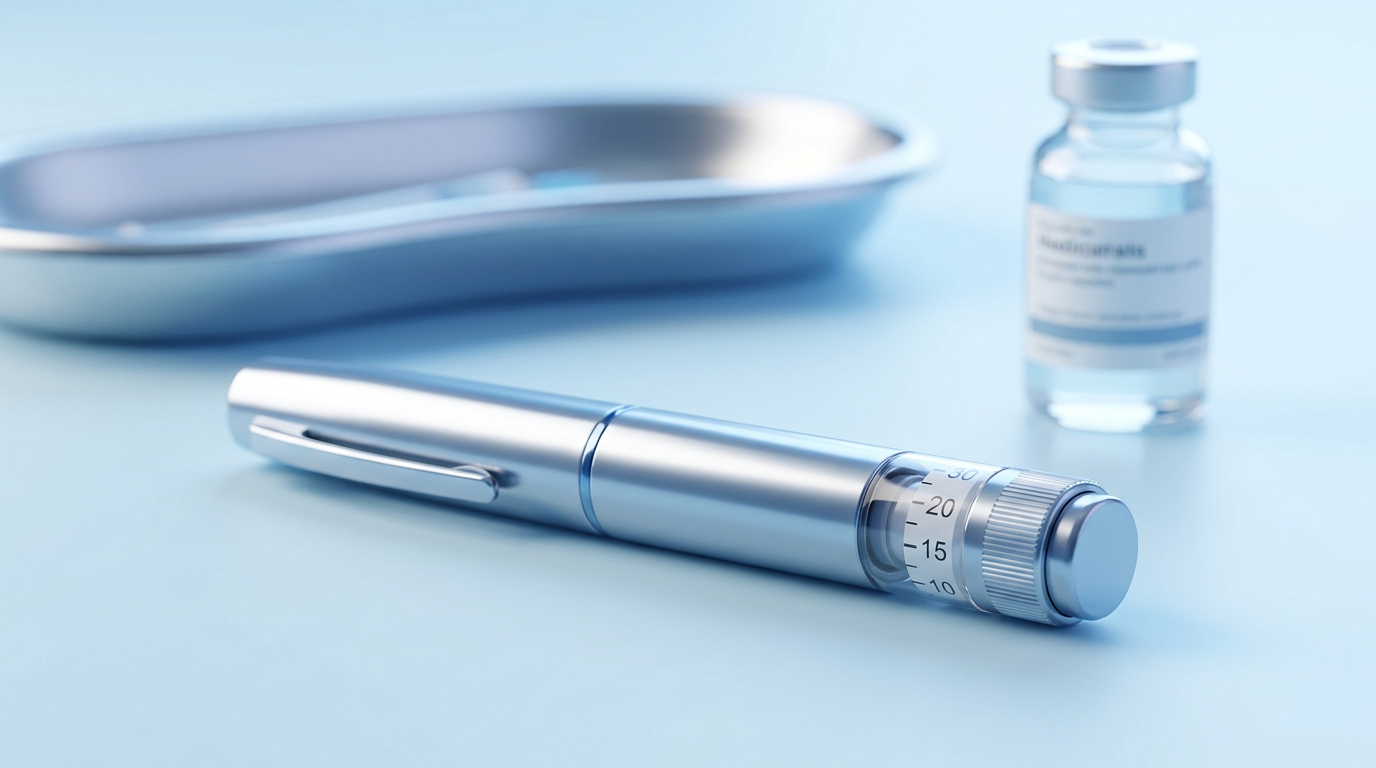
Most of these errors have nothing to do with injection technique. They come from treating milligram numbers as if they transfer between semaglutide products and forms, from trying to produce a smaller weekly amount out of a device built to deliver a fixed one, and from picking back up at an old step after a gap in treatment.
The number belongs to a product, not to the molecule
Semaglutide is sold under several names with different scales attached. Wegovy injection runs from 0.25 mg to 2.4 mg once weekly, with a 7.2 mg presentation available for adults who have already tolerated 2.4 mg and need further weight reduction. Wegovy tablets run on a separate oral scale of 1.5 mg, 4 mg, 9 mg, and 25 mg once daily. Ozempic is the semaglutide product indicated for type 2 diabetes and carries its own numbers and its own schedule.
So hearing that someone else is “on 1 mg” conveys almost nothing usable. The figure means something only once the product, route, and frequency are attached.
Confusion about which number belongs to which presentation is easier to avoid when the branded schedule is written out plainly somewhere first. Manufacturer routes like LillyDirect and NovoCare set out the injection strengths, and among telehealth names such as Ro, Henry Meds, and Hims and Hers, a provider page like HealthRX’s Wegovy reference lists each presentation next to the amount it delivers. Checking one of those before a refill arrives beats untangling a mismatched box during a confusing week.
| Presentation | What the number describes | Frequent misreading |
|---|---|---|
| Wegovy single-dose pen or syringe | One fixed weekly injected amount per device | That a device can be partly used to create a smaller weekly amount |
| Wegovy FlexTouch pen | 2.4 mg per injection, four doses held in one pen | That the four doses can be spread thinner across more weeks |
| Wegovy tablets | A once-daily oral amount on an entirely separate scale | That oral milligrams line up against weekly injected milligrams |
| Ozempic | A type 2 diabetes product with its own titration path | That weight-management timelines apply to it |
| Compounded semaglutide vial | A concentration chosen by the compounding pharmacy | That branded label figures or syringe unit marks carry over |
The devices are built around a single amount on purpose
Each Wegovy injection strength is listed in the labeling as its own presentation, with the total strength stated per total volume. The FlexTouch pen is described as a single-patient-use pen holding four doses of 2.4 mg. Nothing in that lineup is designed to be partly emptied or stretched, and the labeling asks that patients be told which presentation they are getting and trained specifically for it, with fresh training if the presentation ever changes.
That instruction exists because presentations are not interchangeable in the hand even when the active ingredient is identical. Moving from a single-dose pen to a multi-dose pen without new training is the most predictable error in this category.
Tablet handling has its own short list of failures
Oral semaglutide absorption is unusually sensitive to how the tablet is taken, and the labeling reflects that. One tablet is taken daily on an empty stomach in the morning with no more than four ounces of water, and with water only. Tablets are swallowed whole. Splitting, crushing, chewing, or dissolving them is ruled out. Food, other drinks, and other oral medications wait at least 30 minutes.
Splitting a tablet to land on a smaller number is therefore not a smaller dose in any meaningful sense. It is an unmeasured amount taken through a route whose absorption was never characterized that way. The published trial of oral semaglutide at 25 mg tested the intact product taken under those conditions.
Coming back after a gap at the number you left
This one catches people who have been steady for months. The Wegovy injection labeling directs that when two or more consecutive weekly doses are missed, escalation is reinitiated at a lower amount to reduce the risk of gastrointestinal reactions. Tolerance built up over weeks does not survive a long enough pause, and resuming at the previous step is what turns a supply gap or a vacation into a rough fortnight.
Someone who has deliberately settled at a lower maintenance amount is not exempt. The rule is written about consecutive missed doses, not about how high the person climbed.
Who is watching the number matters as much as the number
Handling questions rarely arrive at a convenient moment. They arrive on a Saturday, or the week a fresh box looks nothing like the last one. What decides whether that becomes an error is how fast a prescriber can be reached and whether reaching one costs money.
Those answers differ sharply by route. Endocrinology and primary care practices, manufacturer channels such as NovoCare Pharmacy and LillyDirect, telehealth services including Ro, Hims & Hers, and LifeMD, and physician-supervised compounded medication services such as FormBlends all handle between-visit questions on different timelines and different fee structures. A program that bills per consultation quietly discourages the phone call that would have prevented the mistake, which is worth knowing before signing up rather than during a confusing week.
Compounded preparations are a separate measurement problem
Compounded drugs are not FDA-approved and do not go through premarket review for safety, effectiveness, or manufacturing quality. For semaglutide specifically, the concentration in a compounded vial is set by the pharmacy that made it, so the milligram figures in branded labeling do not describe what is in that vial and neither do generic syringe markings.
The consequences are documented rather than theoretical. A poison control center case series recorded administration errors with compounded semaglutide, including patients who drew up far more than intended after confusing units with milliliters. A pharmacovigilance analysis of adverse event reports involving compounded GLP-1 receptor agonists found dosing errors featuring prominently. Numbers for a compounded preparation come from the prescriber and the dispensing pharmacy, not from a branded label.
What the labeling actually permits when a step is difficult
The escalation schedule is less rigid than it looks. If a patient does not tolerate a step during escalation, the labeling directs that a four-week delay be considered rather than a forced advance. For weight reduction in adults, it names either 1.7 mg or 2.4 mg once weekly as maintenance amounts, with 2.4 mg recommended, and asks that treatment response and tolerability both be weighed when choosing between them.
That is a prescriber’s selection made with the trial evidence in view, since the weight-loss figures people have read about came from participants who reached the higher maintenance amount. Treating it as a self-service adjustment removes the only person able to judge whether a smaller effect is an acceptable trade.
One screening point sits underneath all of this regardless of amount. Semaglutide carries a boxed warning about thyroid C-cell tumors seen in rodents, and it is contraindicated in anyone with a personal or family history of medullary thyroid carcinoma or with multiple endocrine neoplasia syndrome type 2. That question belongs before the first dose.
Frequently asked questions
Can a single-dose pen be used twice to halve the amount?
No. Each Wegovy injection strength is supplied as its own presentation delivering a fixed amount, and none of them is designed for partial use. Attempting it produces an unmeasured injection with no labeled basis, and any change to the weekly amount is a prescriber decision made through a different prescription.
Do the tablet numbers convert to injection numbers?
They do not convert arithmetically. The two forms use separate scales and separate schedules, and the labeling handles switching between them as a defined procedure with its own instructions rather than as a calculation a patient performs. Assuming a conversion is one of the more common sources of confusion here.
Does a lower amount make handling errors less consequential?
Less consequential is not the same as harmless. The warnings in the labeling, including those covering gastrointestinal reactions, dehydration, and gallbladder disease, are not written as applying only above a threshold. An unintended amount is still an unintended amount, and it is still worth reporting.
Is there an equivalent handling guide for compounded vials?
No general one exists, because concentration varies between pharmacies. The instructions that apply are the ones supplied with that specific prescription. Guidance copied from a branded label, a forum, or another patient’s vial does not describe the product in hand.