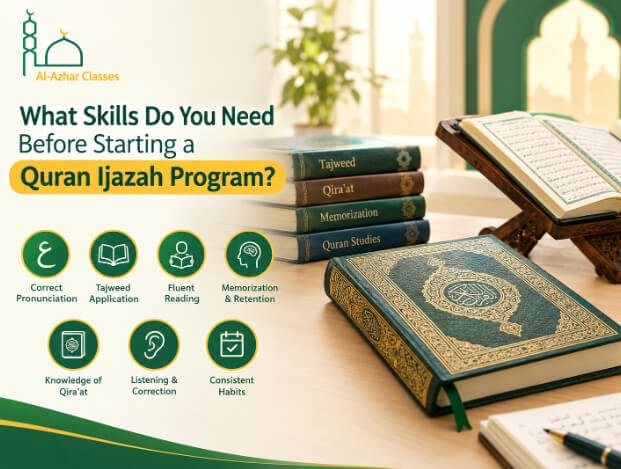
Reciting the Quran well is a goal many Muslims carry for years. A formal recitation certificate places a student inside a living chain of teachers that reaches the Prophet Muhammad (peace be upon him). If you are asking how to get Ijazah in Quran online, the first task is to know which skills to build before you apply, because qualified teachers accept students who already recite at a high standard.
What an Ijazah Certifies
An Ijazah is a teacher’s authorization to pass on the Quran. The student recites to a certified scholar, who listens for errors and grants permission only when the recitation meets the standard. The certificate carries a sanad, a documented chain of narrators running from teacher to teacher.
Two forms are common. A recitation Ijazah confirms accurate reading of the text, and a memorization Ijazah confirms that the student can recite the whole Quran by heart. The Quran has 114 surahs and 30 juz, and its verses are commonly counted as 6,236, so the exam is long and the teacher listens for precision from the first page to the last. Al Azhar Classes states that its Ijazah program is meant for students who have already perfected their Tajweed and, for a memorization Ijazah, their memorization as well.
Skill 1: Accurate Letter Pronunciation
Every Arabic letter has a point of articulation, called makhraj, and a set of qualities, called sifat. Some letters sound alike to a new learner, such as seen and sad, or the two different ha letters, yet they change the meaning of a word. Teachers check these first, because a recitation with blurred throat letters cannot be certified.
Try these habits:
- Record one page each week and compare it with a respected reciter.
- Drill similar letter pairs slowly until the difference is clear in your own voice.
- Ask your teacher which letters you drift on, then give those extra time.
Skill 2: Working Knowledge of Tajweed
Tajweed means giving every letter its right. The core rules cover noon sakinah and tanween, meem sakinah, madd (elongation), qalqalah, and heavy versus light letters. You need to apply them while reciting, not recall them from a chart. A daily routine helps, and this guide to Quran reading with Tajweed at home lists ten practical habits.
A common mistake is learning the rules in theory and postponing practice. A teacher will quickly hear whether a rule has become automatic. Study one rule, find it in your daily reading, and recite it aloud until the habit forms.
Skill 3: Fluent and Steady Reading
Before an Ijazah session begins, you should be able to read directly from the Mushaf without sounding out each word. A fluent reader can move through a page of the 604-page Madinah Mushaf without stopping to decode letters. Hesitation breaks the flow of Tajweed rules, and a long recitation exam makes that weakness easy to hear.
Fluency grows with volume. Fifteen to twenty minutes of daily reading, with a teacher reviewing your pace and accuracy every week, tends to work better than occasional long sessions.
Skill 4: Memorization and Retention
A memorization Ijazah requires the full Quran by heart, and even a recitation Ijazah may include questions on memorized portions. Strong learners follow a three-part cycle: a new lesson, a revision of recent lessons, and a revision of older material. Without the last two parts, earlier pages fade as new ones are added.
A step-by-step look at Quran memorization online from beginner level to Ijazah shows how this cycle works over time. Retention improves with a fixed revision time and a teacher who tests you often.
Skill 5: Basic Familiarity With Qira’at
The Quran is transmitted in ten canonical recitation styles, called qira’at. Most Muslims worldwide recite in Hafs from Asim, while Warsh from Nafi is common in parts of North and West Africa. An Ijazah is granted for a specific riwayah, so you should know which one you are studying and why. This overview of the types of Qira’at explains the differences in plain language.
You do not need to master several riwayat before starting. Knowing the name of your chosen riwayah and the teacher chain behind it is a good starting point.
Skill 6: Listening and Accepting Correction
Ijazah is an oral tradition. The student recites, the teacher corrects, and the student repeats until the sound is right. Students who argue with every correction or rush through them slow their own progress. Write each correction down and fix it before the next lesson. Practical ways to use lesson time well are covered in this guide to working with an online Quran tutor.
Skill 7: Consistent Study Habits
The time an Ijazah takes varies widely with your starting level and the hours you can give each day. Short sessions at a fixed time usually beat irregular marathons. Adults with full schedules can find realistic routines in this article on how to study Quran regularly. Pick a time, keep the session short, and protect it.
How Teachers Judge Readiness
A teacher usually begins with a short listening assessment. You recite a few pages from different parts of the Quran, and the teacher notes your pronunciation, Tajweed, fluency, and recall before suggesting where to start. Treat it as a map of your current level. A student who hears honest feedback early can fix weak areas well before the final recitation, while one who hides them tends to meet the same problems at the worst moment.
Common Challenges Students Face
- Skipping foundations: learners rush toward the exam and carry old pronunciation errors into advanced lessons.
- Uneven schedules: work, school, and family interrupt weekly lessons.
- Missing your own mistakes: without live correction, errors become habits.
- Finding a verified teacher: a genuine Ijazah needs a sanad that can be traced.
- Fatigue during long review: reciting for hours demands steady stamina.
Trends in Ijazah Learning
Online study has widened access to qualified scholars. Teachers can now be reached across time zones, and some providers list availability around the clock. Digital tools such as color-coded Tajweed text also make rules easier to see while reading. Students comparing Ijazah certification courses should check how the teacher’s sanad is documented and what Tajweed level is required before enrollment.
A Quick Readiness Check
Answer these honestly before you apply:
- Can I read any page of the Mushaf without stopping?
- Can I name the Tajweed rule in a verse and recite it correctly?
- Do I know which riwayah I will study?
- Can I give a fixed time to practice each day?
- Can I accept correction from a teacher without frustration?
If most answers are yes, you are ready to speak with a teacher about enrollment. If not, spend a few more weeks on the weak area first.
Frequently Asked Questions (FAQs)
1. How long does it take to get an Ijazah in the Quran online?
The time depends on your starting level, daily practice, and the teacher’s standard. Students who already read fluently with correct Tajweed usually move faster. An accelerated online Quran program suits that kind of student, while beginners should expect to build their foundations first.
2. Do I need to memorize the whole Quran before applying?
Only for a memorization Ijazah. A recitation Ijazah asks for accurate, fluent reading of the text, although a teacher may still test some memorized portions. If memorization is your goal, this guide on how to memorize the Quran explains a sensible daily method.
3. Is Tajweed required before starting an Ijazah course?
Yes. Teachers expect you to apply the core rules correctly while reciting, since the Ijazah exam checks pronunciation and rule application together. If you are unsure why this matters, read whether you must recite Quran with Tajweed at all.
4. Can adults start preparing for an Ijazah?
Yes. Many adults begin later in life and succeed with a fixed schedule and a patient teacher. Adults interested in memorization can look at hifz Quran classes for adults to see how lessons are arranged around work and family.
5. How can beginners prepare for an Ijazah program?
Start with letter pronunciation, then add Tajweed rules, then build reading fluency. A structured plan for learning Quran with Tajweed in 6 months shows how to pace these stages. Review each stage with a live teacher so errors do not become habits.
6. Do I need to know Arabic grammar for an Ijazah?
Teachers usually do not require grammar knowledge for a recitation Ijazah, but it helps you understand what you recite and read with more confidence. Learners who want that extra depth can start with Quranic Arabic online alongside their recitation lessons.
See also: Top Reasons to Hire Bus Accident Lawyers After a Serious Collision
Conclusion
The skills to build before an Ijazah are clear: accurate letters, practiced Tajweed, fluent reading, reliable memory, a working idea of qira’at, openness to correction, and steady habits. Build them in that order and the exam becomes a review of work you have already done. Al Azhar Classes offers one-to-one online guidance with experienced teachers, so you can check your level, strengthen weak areas, and move toward your certificate at a pace that suits your life.